
The automated external defibrillator (AED) is a vital medical device that protects lives. As an emergency medical device, its reliability and accuracy often determine whether a life can be saved immediately. Therefore, AED manufacturers place extremely high demands on quality inspection during product development and mass production. However, traditional testing methods present challenges such as time consumption, errors, and labor burden. With the rise of automation in the medical device industry, ensuring test accuracy while improving production efficiency has become a critical issue for manufacturers.
This article will explore the value and specific practices of automated testing in the AED production process from three aspects: in-process testing, final testing, and other applications.
In-Process Testing: Focuses on PCBA and module function inspection
Semi-product testing primarily targets printed circuit boards (PCBAs) or functional modules that haven't yet completed final assembly. Through customizable testing processes, it confirms that circuit and component performance meet design specifications. This stage doesn't include functional verification after the entire device is assembled; instead, it focuses on ensuring the quality of the underlying electronic hardware.
Typical testing items include:
- Circuit connection test (ICT): Check whether there are open circuits or short circuits in the PCBA, and whether all components are well soldered.
- Functional Test (FCT): After burning the firmware, check whether the basic functions of the IC and module are normal, and check whether the output signal waveform, voltage and current are stable
- Impedance and leakage current test: Ensure that the electrical impedance is reasonable and the leakage current intensity is within a safe range
- Withstand voltage and insulation test: Verify the PCB's voltage tolerance and insulation performance to ensure safe use
- Environmental simulation test (optional): such as vibration, high temperature and high humidity test, to check component stability
- PCB aging test: This test simulates long-term use through multiple discharges to ensure module stability and reliability. This standard is adopted by most international manufacturers.
DFS400 in in-process testing:
The WhaleTeq DFS400 AED/Defibrillator Tester supports both production line testing and individual product testing of semi-products, integrating the functions of multiple devices into one, including functional testing, impedance simulation, and signal stability analysis. Its intuitive software interface allows engineers to quickly configure and automatically record test data. With a range of impedance simulation options from 25Ω to 200Ω, it accurately reflects different human body conditions, helping manufacturers quickly screen semi-product quality and prevent defects from entering back-end assembly.
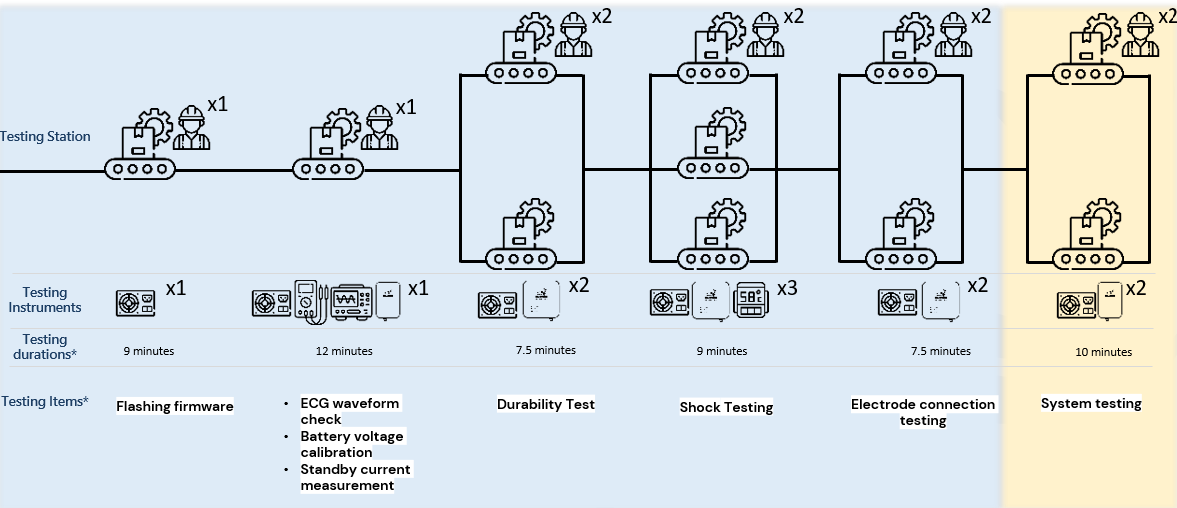
Figure 1: Batch testing of in-process AEDs on the production line, with one unit tested every 7.5 minutes on average.
 Figure 2 : Testing an in-process AED using the DFS400 AED /defibrillator tester connected to customized testing software,
Final Testing: Simulates real-world usage scenarios from a system integration perspective
The purpose of final testing is to verify the overall system, checking whether the integrated software (firmware and algorithms) and hardware function as expected. This stage does not simply verify the algorithm design, but rather fully simulates the various conditions and reactions encountered during actual product use.

WhaleTeq recommends that final testing should include at least the following three key items:
- Discharge test
Traditional methods require manual observation of energy release and recording of data with external instruments, a time-consuming process and subject to interpretation errors. With the DFS400 AED/defibrillator, the instrument calculates energy within seconds and directly outputs a pass/fail result, eliminating manual recording errors.
- Heart rhythm detection and system verification
Using an ECG database, we simulated various clinical heart rhythms, such as ventricular fibrillation and bradycardia, to test the system's ability to accurately identify and respond promptly after integration. This verification focused on the system-level functionality of the hardware and software integration , ensuring correct version matching and proper system operation.
- User interface and voice commands testing
Confirm that the product's prompt voice, light display, and button feedback are in accordance with the design to ensure clear and correct guidance during emergency use.
DFS400 assists final testing features:
- Integrated multifunctional design simplifies the testing process
Integrate a defibrillator tester, impedance box, and oscilloscope to reduce signal interference and operational difficulties between multiple devices, allowing you to complete testing in one place.
- Automatic data recording and report output
DFS400 automatically saves the data and waveform of each electric shock, establishing a complete and traceable quality process, facilitating production monitoring and problem tracing.
- Repeatability and Reproducibility (R&R) function
Compare hundreds to thousands of test waveforms to ensure that shock waveforms, energy, and frequency consistently meet stringent standards, enhancing product reliability.
- Provide free software development kit (SDK)
Allows users to customize fully automated testing software to improve mass testing efficiency, especially suitable for peak production periods, effectively reducing manpower burden.
Other applications: fully automated robotic arms and aging tests
- Fully Automation Test
For high-volume production, automated testing with robotic arms can significantly save manpower and increase production capacity. The robotic arms are responsible for plugging and unplugging test cables and switching test states, enabling 24-hour uninterrupted operation, making them particularly suitable for production environments with extremely high annual shipment volumes.
- Aging Test
To ensure AEDs maintain stable operation in harsh environments like high temperature and humidity, aging test has become an essential quality control measure. Automated testing platforms can simultaneously monitor a large number of devices over extended periods in simulated environments, providing immediate alarms upon detection of anomalies and enhancing product reliability.

Figure 4: AED aging test ensures the AED can withstand actual environmental changes and maintain product stability.
AED automated testing triples efficiency, quality, and confidence
AED production quality directly impacts patient safety, so testing is crucial. In-process testing focuses on confirming the integrity of hardware and assembly to prevent hidden defects. Final testing simulates the overall system's operational environment at a high level, verifying the true effectiveness of hardware and software integration. Incorporating automated technology improves testing efficiency, reduces human error, ensuring consistent and traceable quality.
WhaleTeq is committed to providing comprehensive automated testing solutions to help AED manufacturers achieve faster and more reliable production line operations, ensuring the performance and safety of every AED leaving the factory.