


Origins
Following the COVID-19 pandemic, at-home blood oxygen monitoring has become a global priority in both clinical care and personal health management, driving widespread adoption of finger pulse oximeters.
At the same time, growing clinical evidence and international studies have highlighted that darker skin tones, low peripheral perfusion, and cold environments can cause pulse oximeters to produce systematic measurement error—sometimes resulting in apparently normal SpO₂ values despite actual hypoxemia. As a result, ensuring accuracy and consistency under real-world conditions has become a critical challenge in oximeter development.
In its review process and guidance for transmittance pulse oximeters, the FDA emphasizes performance evaluation under varying skin tones and low-perfusion (low-PI) conditions, and encourages test designs that better reflect real clinical use—supported by traceable and reproducible validation evidence.
Consequently, the ability to reliably reproduce low-PI states and differentiated optical conditions under controlled settings, and to systematically evaluate measurement consistency, is essential to modern pulse oximeter testing.
Through close collaboration with leading manufacturers and R&D engineers, we identified a clear industry need for a single testing solution that applies to development, verification, and mass production—one that enables precise control of red (R) and infrared (IR) optical parameters, reliable low-PI simulation, and high-throughput consistency testing, all while improving traceability and shortening iteration cycles.
This insight led to the development of the PPG-2TF-660 2.0 Transmittance SpO₂ Module.
The PPG-2TF-660 2.0 allows engineers to freely configure AC and DC values, waveforms, frequencies, and amplitudes for both red and infrared channels, and to set PI values as low as 0.01%. This capability enables the realistic simulation of challenging conditions such as dark skin tones, cold environments, and compromised peripheral circulation, supporting the robust verification of oximeter stability and consistency.
In addition, the tester can automatically calculate device-specific red and infrared DC values and generate a custom R-curve, streamlining large-scale testing and quality verification. This ensures faster, more consistent workflows across R&D and production lines, while safeguarding measurement accuracy and long-term reliability.
We believe that only by grounding pulse oximeter testing in real clinical risks and regulatory expectations can manufacturers confidently validate performance across diverse populations and environments. The PPG-2TF-660 2.0 is designed to help achieve exactly that—serving as a reliable testing partner for manufacturers committed to accuracy, consistency, and patient safety.
Functions
 Basic Waveform Output
 PPG Signal Generation
 Adjustable PWTT Pulse Wave Transit Time
 Blood Oxygen R Curve Simulation
 Saving Test Parameters
 Raw Data Playback
 Simple Automated Test
Outputs PPG Waveform, Sine, Triangle, and Square. Users can adjust large and precise parameters according to needs, and DC offset signal testing.
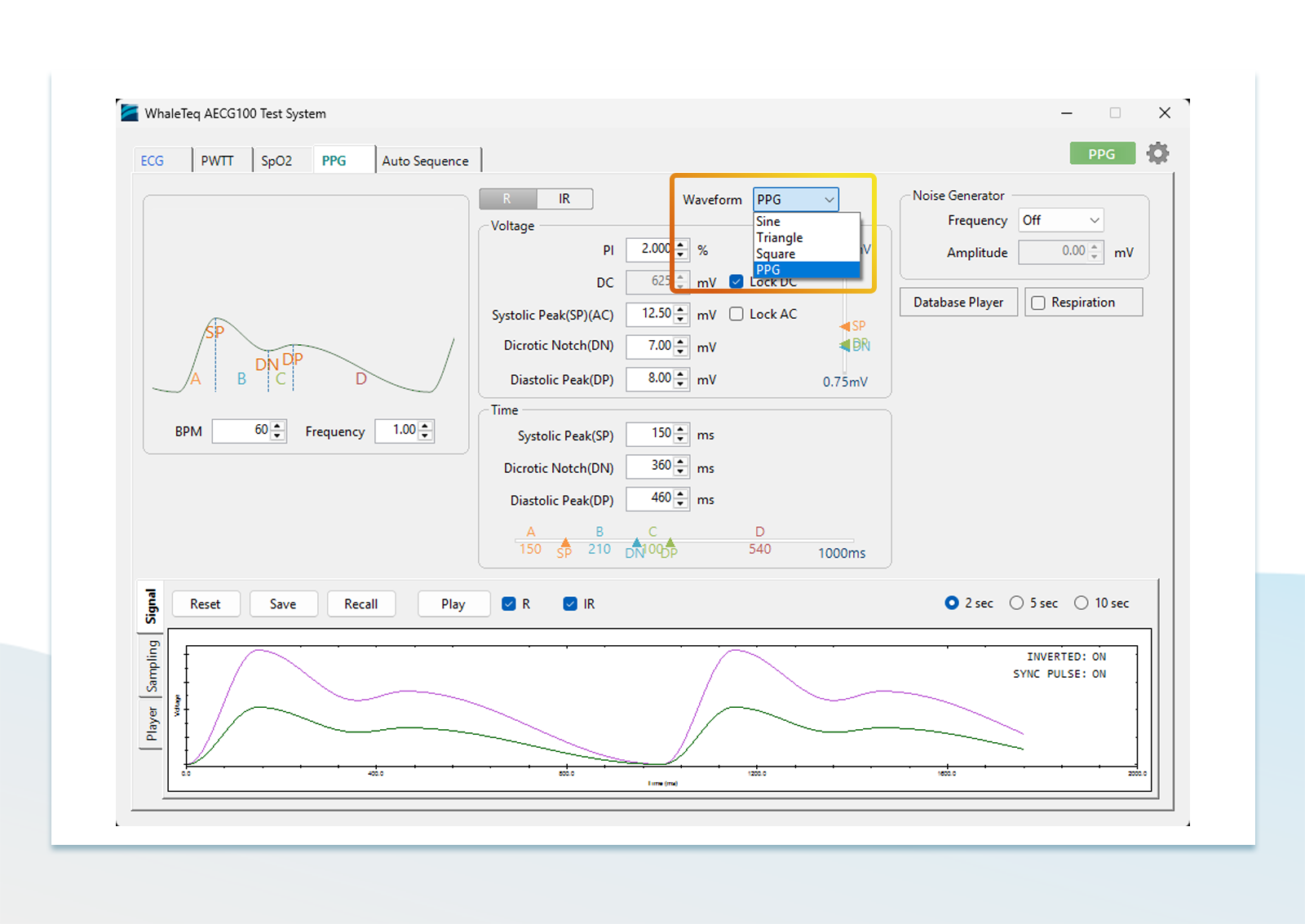
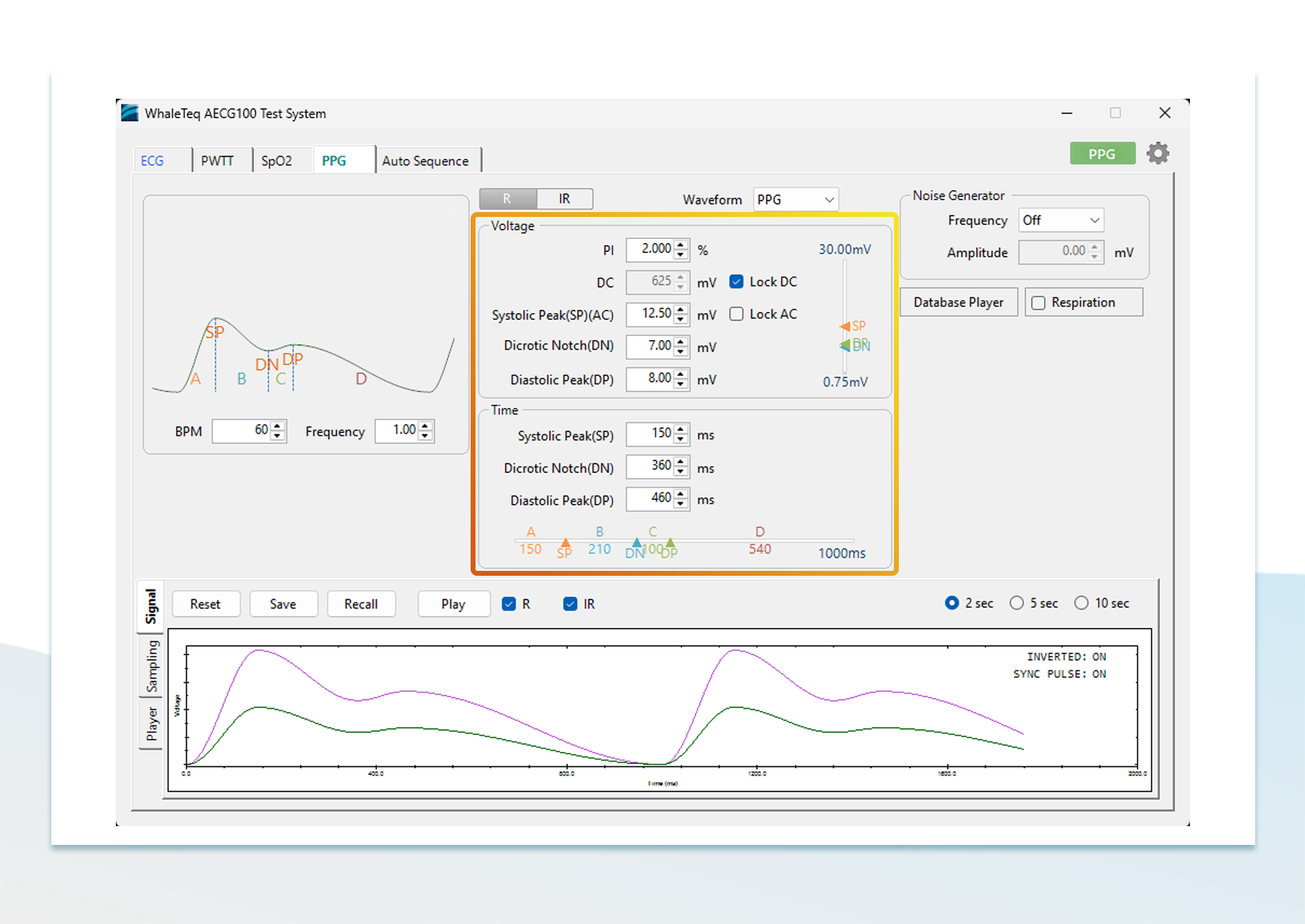
Simulates Sine, Triangle, and PPG analog signals, providing analog signals of red and infrared light. It can measure transmittance PPG heart rate, SpO2, adjust the characteristic points of the PPG waveform in a large range and in detail. Including Systolic Peak (SP), Dicrotic Notch (DN), Diastolic Peak (DP), etc., elastically conduct specific tests.
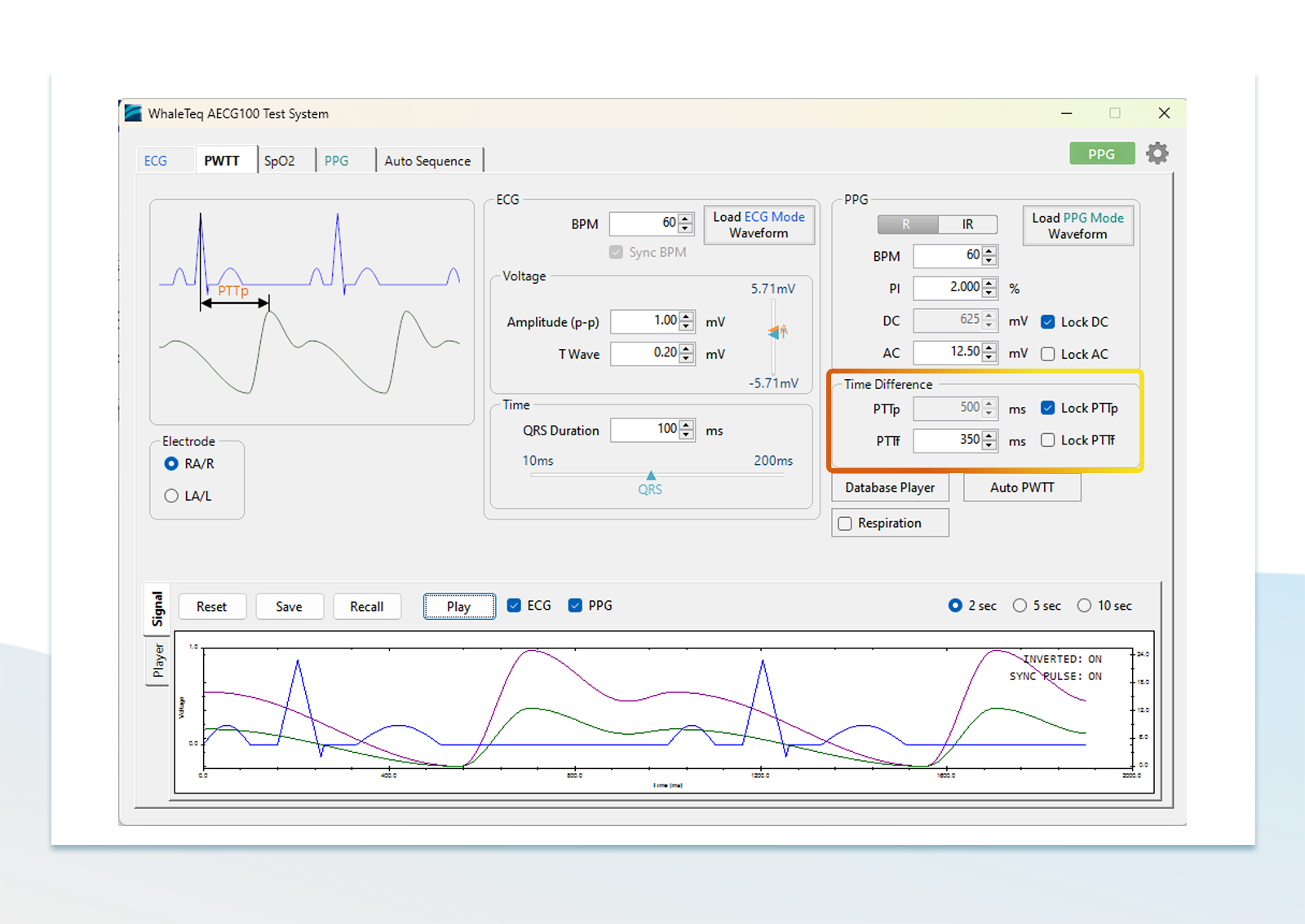
Simultaneously send out ECG and PPG signals, adjust the time difference (PTTp and PTTf) between the two signals, and verify the accuracy of the blood pressure algorithm of DUT.
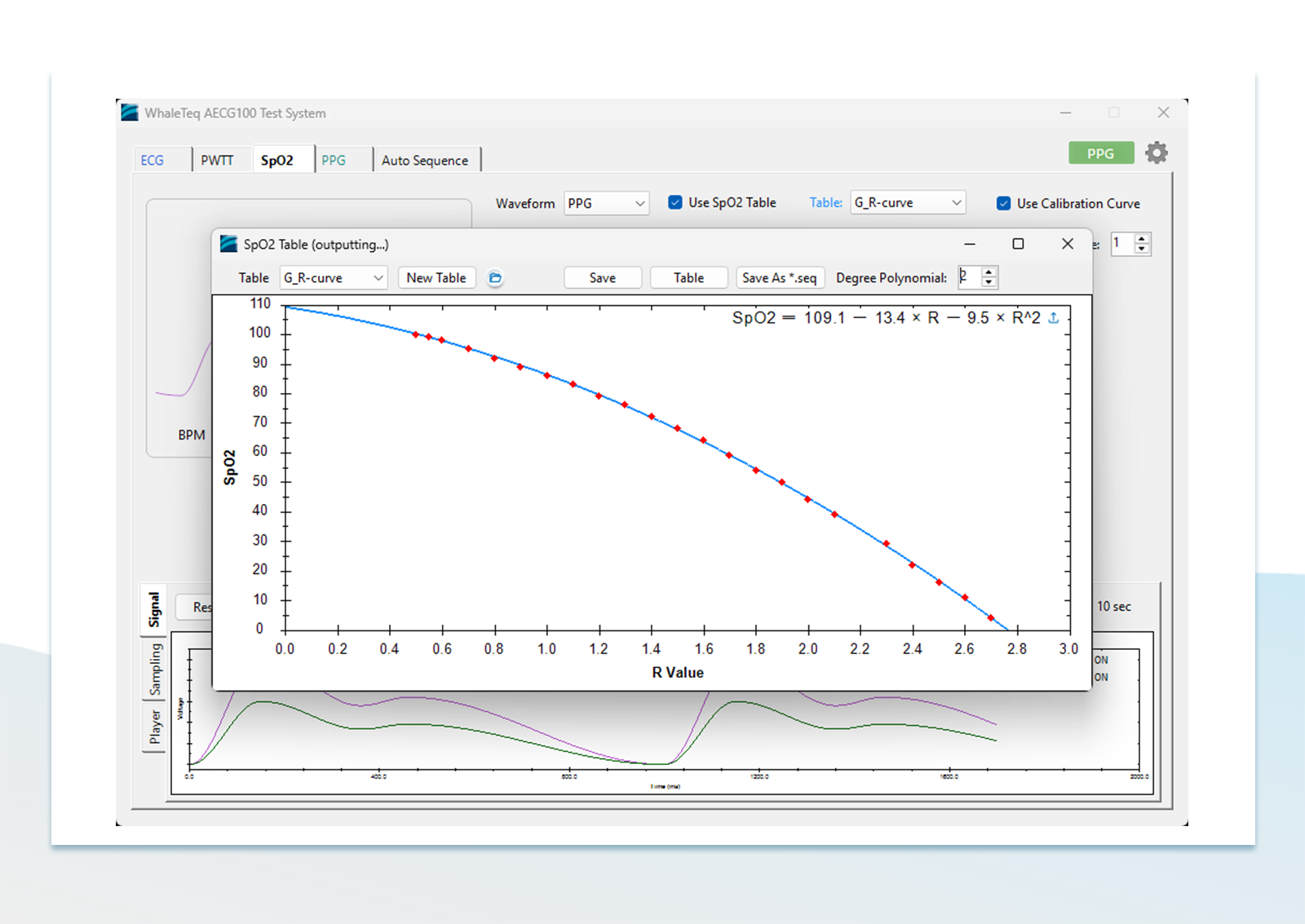
By establishing a device-specific R curve for DUT, manufacturers can more accurately validate SpO₂ and Perfusion Index (PI) specifications.
This approach enables R&D teams to enhance overall measurement accuracy and can be seamlessly extended to QA and production for high-throughput testing of the same model, ensuring consistent quality across units.
Saves test parameters of different test items for integrated testing to reduce human errors.
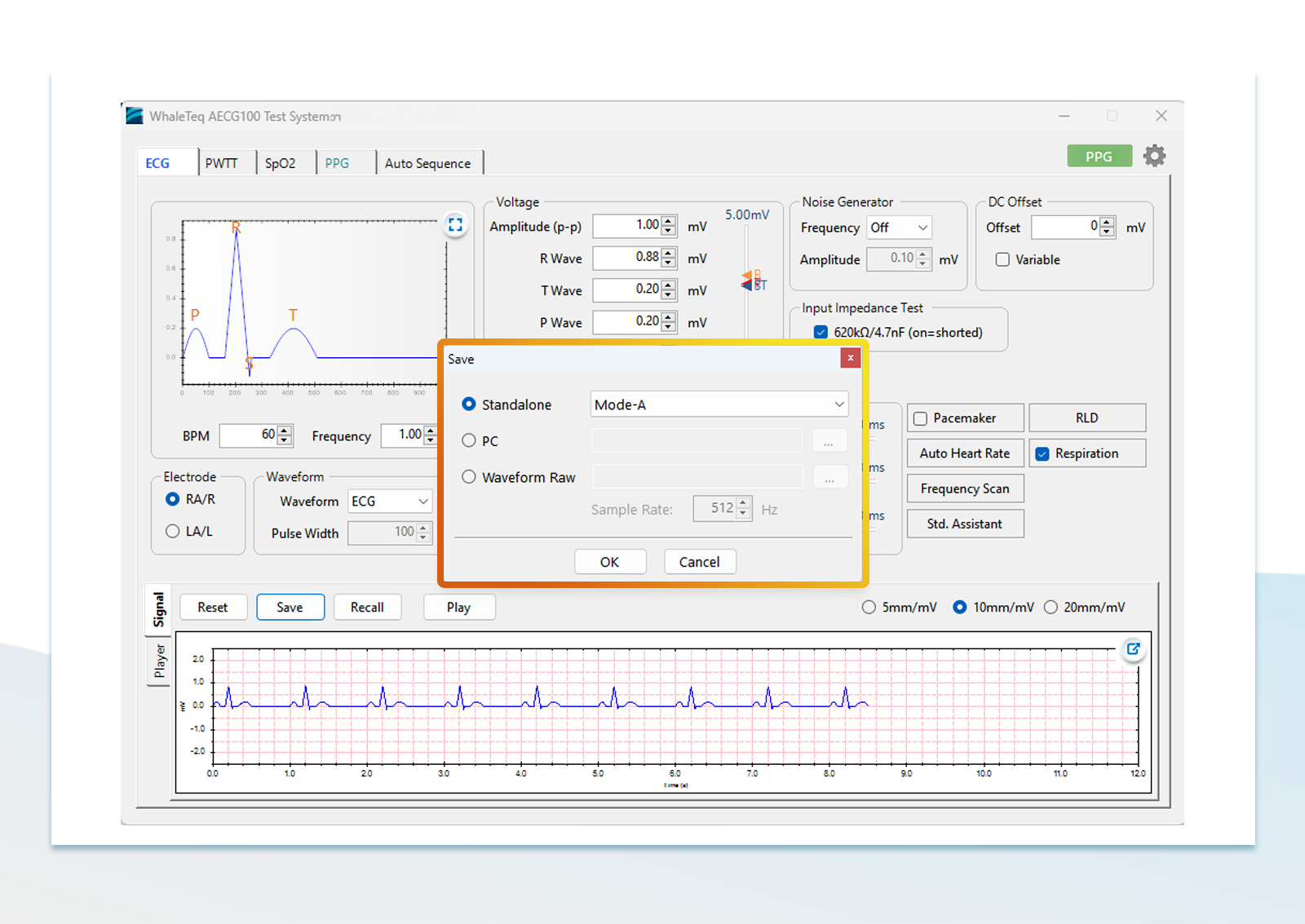
Playback raw data waveforms and reproduce clinically recorded or customized waveforms.

Supports automated testing, using software to control the entire testing process, and can also manually edit auto-sequence for testing.

Highlights
Wide Testing Range to Meet Different Types of Finger Testing Needs

- Wide range of light intensity adjustment and dynamic light detection functions
- Simulates signals of different fingers, built-in reflectance table
Simulations that Are Closer to Time and Real Situations

- Built-in 14 types of ambient light signal superposition
- Provides respiratory variation simulations
Customize or Load the Blood Oximeter R Curve for Quick Verification

- Quickly establish the R curve of the DUT to test the quality consistency and accuracy of the oximeter
- Provides R-curve examples of major brand manufacturers as reference for development
Software Development Kit for Flexible Development of Testing Program

- Users can develop automated testing software according to their needs to control the testing process, reducing the burden of repetitive operations during extensive testing
SpO2 Test Mode
| Parameters | Specifications | |
|---|---|---|
| Heart Rate | Setting Range | 10—300BPM |
| Minimum Step Size | 1BPM | |
| Accuracy | ±1BPM | |
| LED DC Level Reference Output | Setting Range (1) | 300—3000mV |
| Minimum Step Size | 1mV | |
| LED AC Level Reference Output | Setting Range (1) | 0.1—300mV |
| Minimum Step Size | 0.01mV | |
| PI (AC level / DC level) (2) | Setting Range | 0.01%—20% (AC / DC, varies with AC or DC level) |
| LED1 Absolute Irradiance (100%)§ | Intensity | 2.36mW / m^2nm |
| Accuracy | ±10% | |
| LED2 Absolute Irradiance (ambient light)§ | Intensity | 0.25mW / m^2nm |
| Accuracy | ±10% | |
| LED Scan Rate | Rate | 50—40kHz (Normal mode / Standalone mode) (3) 10kHz (Raw data mode) |
| Accuracy | ±5μs | |
| PD Sample Rate | Rate | 250kHz (Single channel) |
| Accuracy | ±5μs | |
| PD Response Time | Rising | 1μs Typical (4) |
| Falling | 1μs Typical (4) | |
| SpO2 % SpO2 parameter specifications (5) | Setting Range | 1%—100% |
| Minimum Step Size | 1% | |
| Accuracy | 91%—100%: ±1% + specified accuracy of the DUT 81%—90%: ±2% + specified accuracy of the DUT 71%—80%: ±3% + specified accuracy of the DUT Below 70%: with unspecified accuracy | |
| §Data Collection Method: To connect the spectrometer with a 2-inch integrating sphere, and fix the integrating sphere on the DUT to measure the absolute irradiance of the LED of the DUT. Note: | ||
SpO2 Test Mode Parameters
| Parameters | Setting Range | Default Values | Minimum Step Size |
|---|---|---|---|
| Output Waveform | Sine / Triangle / PPG | PPG | - |
| BPM | 10—300BPM | 60BPM | 1BPM |
| SpO2 | 0—100% | 98% | 1% |
| Red | |||
| PI (AC level/DC level) | 0.01—20% | 2.000% | 0.001% |
| AC | 0.1—300mV | 12.50mV | 0.01mV |
| DC | 300—3000mV | 625mV | 1mV |
| Output DC (offset) | 0—2000mV | 0mV | 1mV |
| Lock | Lock AC/DC | Lock DC | - |
| Infrared | |||
| PI (AC level/DC level) | 0.01—20% | 4.000% | 0.001% |
| AC | 0.1—300mV | 25.00mV | 0.01mV |
| DC | 300—3000mV | 625mV | 1mV |
| Output DC (offset) | 0—2000mV | 0mV | 1mV |
| Lock | Lock AC/DC | Lock DC | - |
PPG Test Mode Parameters
| Parameters | Setting Range | Default Values | Minimum Step Size | |
|---|---|---|---|---|
| Output Waveform | Sine / Triangle / Square / PPG | PPG | - | |
| BPM | 10—300BPM | 60BPM | 1BPM | |
| Frequency | 0.17—5 | 1.00 | 0.01 | |
| Red / Infrared (Voltage) | ||||
| PI | 0.01—20.000% | 2.000% | - | |
| DC | 300—3000mV | 625mV | 1mV | |
| Systolic Peak (SP) (AC) | 0.1—300mV | 12.50mV | 0.01mV | |
| Dicrotic Notch (DN) | 0.1—300mV | 7.00mV | 0.01mV | |
| Diastolic Peak (DP) | 0.1—300mV | 8.00mV | 0.01mV | |
| Lock | Lock DC: only voltage of DC locked Lock AC: voltage of AC, DN, DP locked | Lock DC | - | |
| Red / Infrared (Time) | ||||
| Systolic Peak (SP) (AC) | 0—1000ms (60BPM) | 150ms | 1ms | |
| Dicrotic Notch (DN) | 0—1000ms (60BPM) | 360ms | 1ms | |
| Diastolic Peak (DP) | 0—1000ms (60BPM) | 460ms | 1ms | |
| Noise Generator (Time) | ||||
| Frequency | off / 0.5 / 1 / 2 / 3 / 5 / 10 / 25 / 50 / 60 / 100 / 120 / 1K / 5K Hz / White Noise | off | - | |
| Amplitude | 0.05—2.00mV | 0mV | 0.05mV | |
| Respiration | ||||
| Respiration Rate | 1—150BrPM | 20BrPM | 1BrPM | |
| Inhale-Exhale Ratio | 1:1、1:2、1:3、1:4、1:5 | 1:1 | 1 | |
| Wave Modulation | Baseline / Amplitude / Frequency | Baseline / Amplitude / Frequency | - | |
| Respiration – Baseline Modulation | Variation – R: 1—16% Variation – IR: 1—16% | 1% 1% | 1% 1% | |
| Respiration – Amplitude Modulation | ||||
| Respiration – Frequency Modulation | ||||
| Apnea Selection | Duration | 1—60s | 10s | 1s |
| Cycle | 1—10min | 1min | 1min | |
Auto Test SpO2 Test Mode Parameters
| Parameters | Setting Range | Default Values | Minimum Step Size |
|---|---|---|---|
| BPM | 10—300BPM | 60BPM | 1BPM |
| SpO2 * | 0—100% | 98% | 1% |
| IR – PI | 0.01—20% | 2.4% | 0.1% |
| Transmission Rate | Neonatal Foot Dark & Thick Finger Dark Medium Finger Normal Medium Finger Light & Medium Finger Light & Thin Finger | Normal Medium Finger | - |
| *Note: SpO2 accuracy: 91%—100%: ±1% + specified accuracy of the DUT 81%—90%: ±3% + specified accuracy of the DUT 71%—80%: ±5% + specified accuracy of the DUT Below 70%: with unspecified accuracy | |||


SpO2 Module
| Part No. | Image | Description | Quantity |
|---|---|---|---|
| 100-AE00018 | 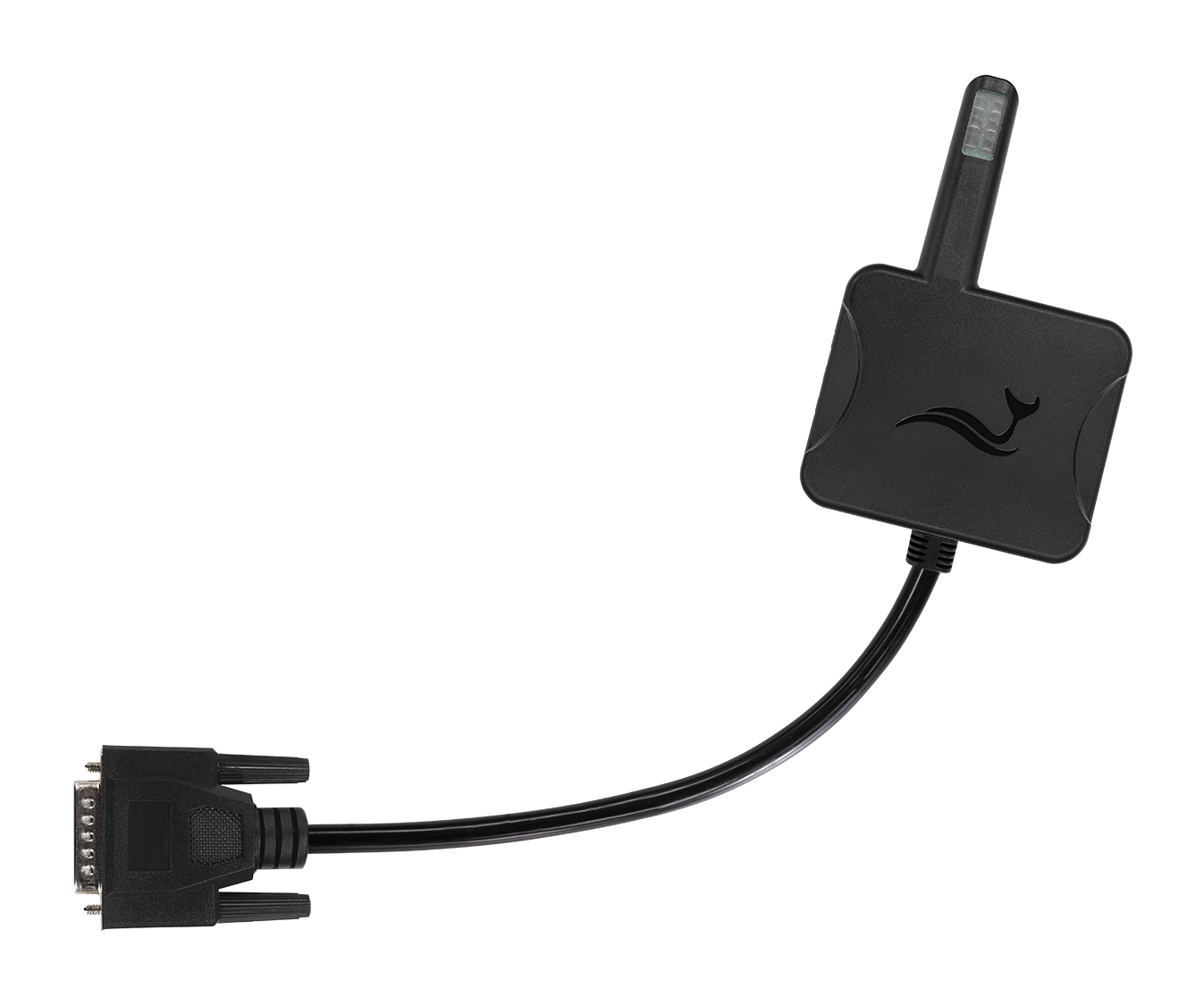 | Model No.: PPG-2TF-660 2.0 Model Name: Transmittance SpO2 module Package contents: • PPG-2TF-660 2.0 x 1 • USB Type-C to Type-C cable (male to male, 150cm, black) x 1 • MCX (RF) male to BNC cable (30cm) x 2 | 1 |
Compatible Products
| Part No. | Image | Description | Quantity |
|---|---|---|---|
| 100-AE00001 |  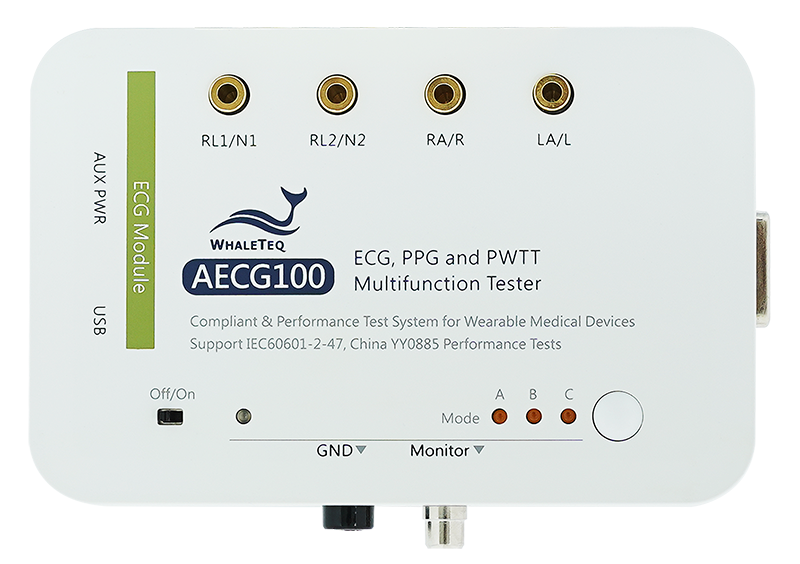 | Model No.: AECG100 The main console unit for ECG testing. | 1 |
| 100-EC00002 | 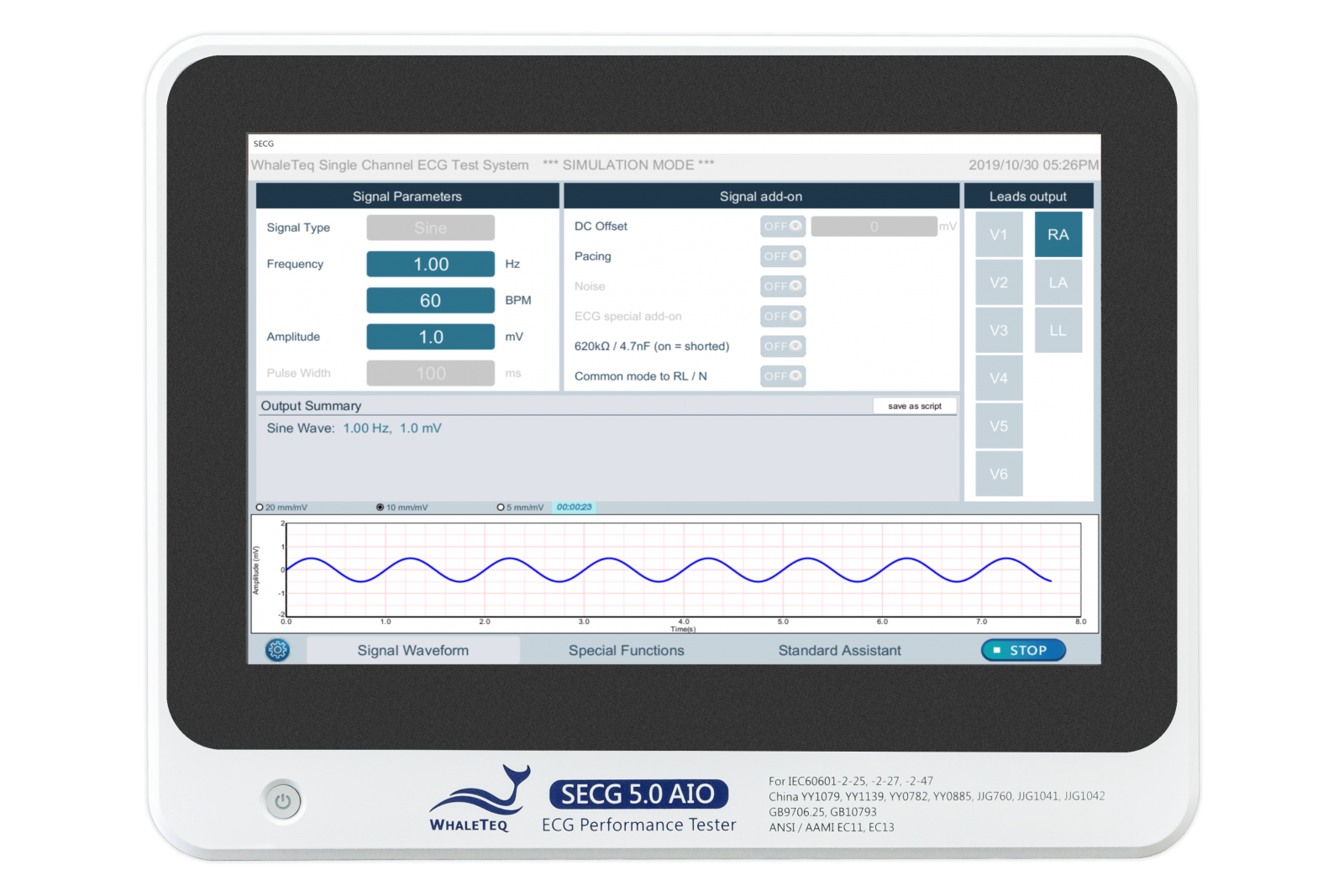 | Model No.: SECG 5.0 AIO Model Name: Multi Vital Sign Simulator The standalone ECG simulator with 12 leads (RA, LA, LL, N, V1 - V6) output for ECG performance tests. | 1 |
Optional Accessories
| Part No. | Image | Description | Quantity |
|---|---|---|---|
| K27-1500301 | 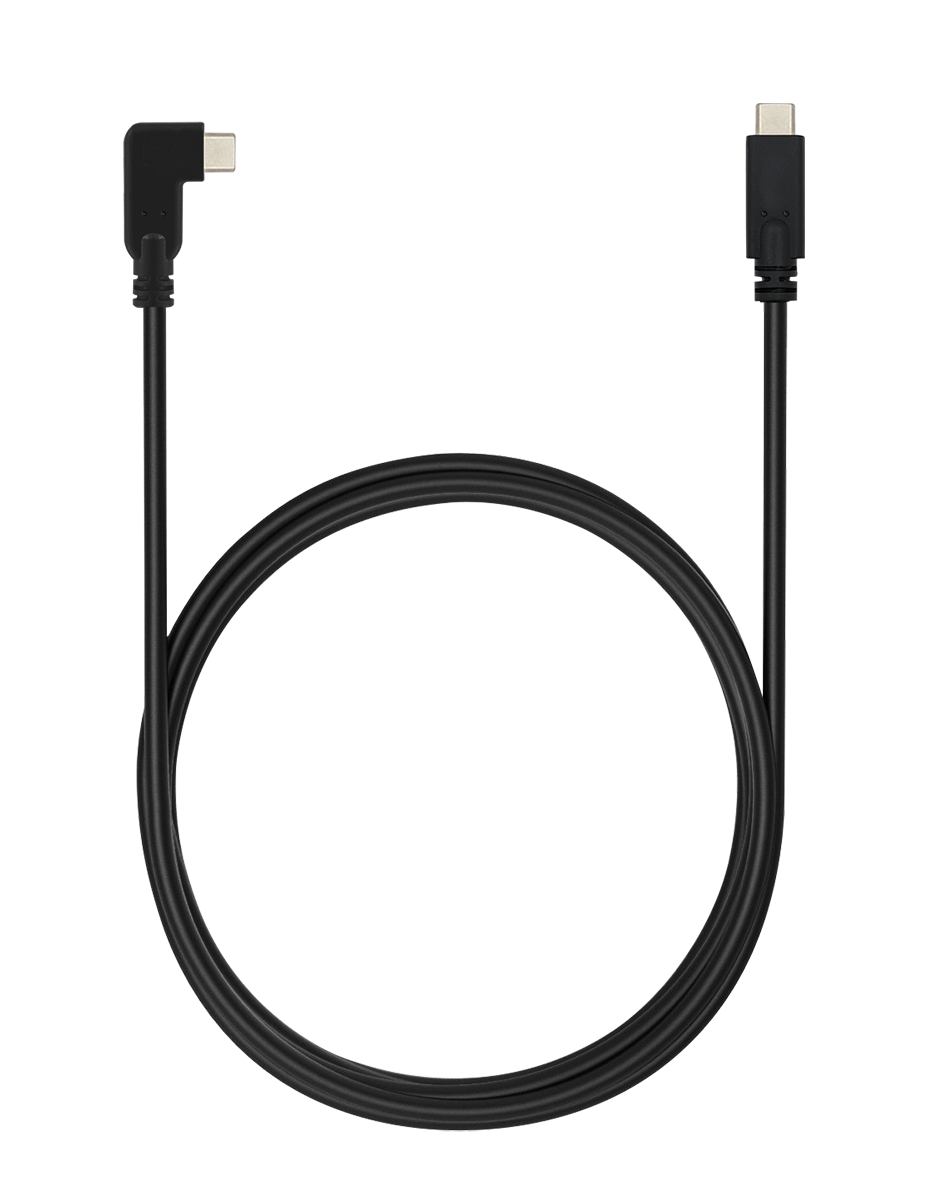 | USB Type-C to Type-C cable (male to male) (150cm) (black) | 1 |
| K29-0300601 | 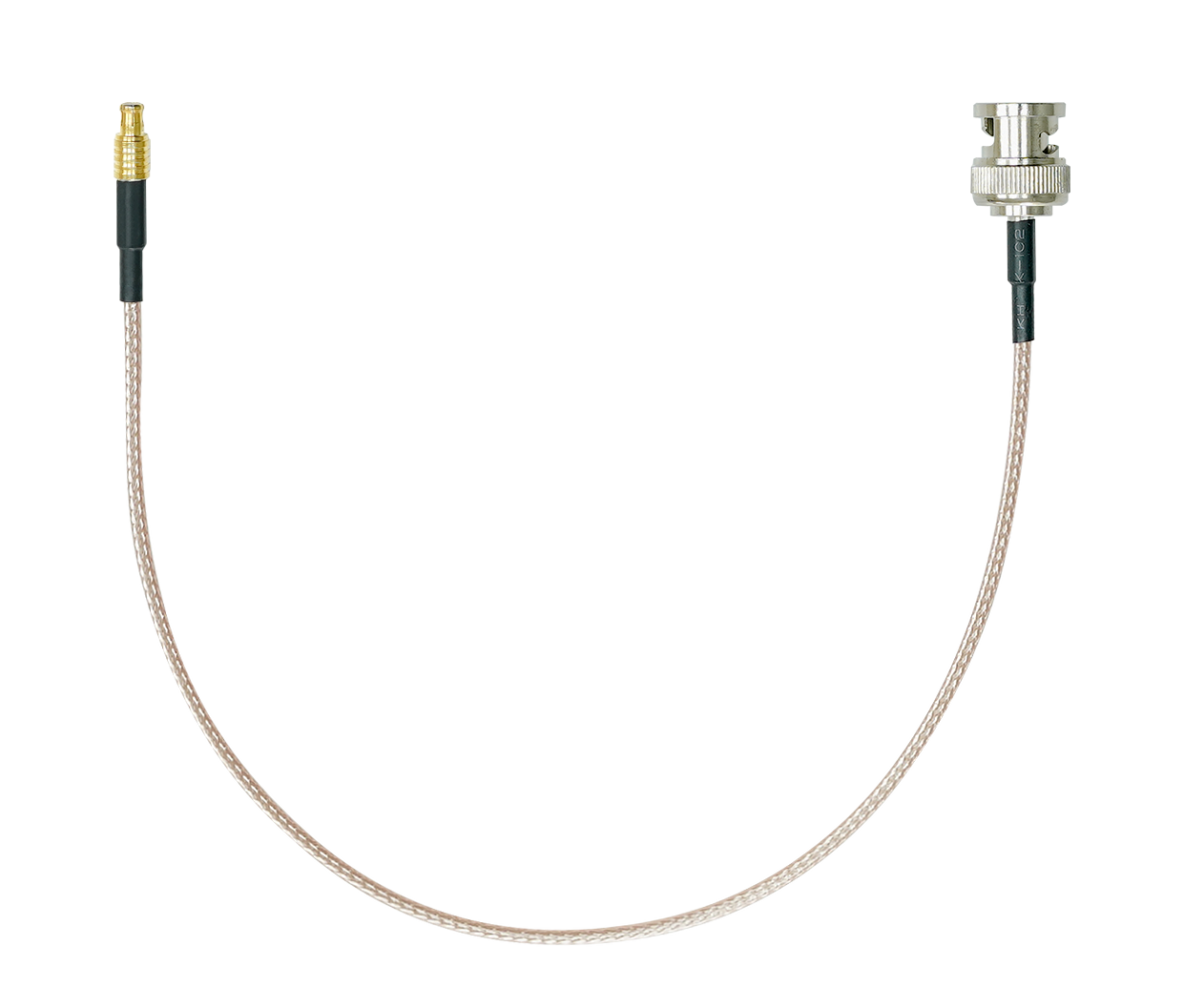 | MCX (RF) male to BNC cable (30cm) | 1 |
Optional Calibration Service and Warranty Extension
| Part No. | Description |
|---|---|
| YY0007 | Model No.: C3 Provides (3) years of calibration service coverage. WhaleTeq equipment can be calibrated to original performance on the basis of (1) year interval. |
| YY0008 | Model No.: R3 Extends the limited warranty from (1) year to (3) years. |
 Datasheet
 User Manual


